The Wrack

wells national estuarine research reserve

Saco River Estuary Project

April 25, 2011 By Scott Richardson Filed under Project Tags: communityctpsaco river

Associated People Chris Feurt Michele Dionne Jacob Aman Jeremy Miller Annie Cox

About the Project

The goal of this project is to protect the Saco River estuary so it will continue to provide services and values to surrounding communities. Investigators are seeking to understand the effects of increasing coastal development on the health of the Saco River estuary and to identify ways to mitigate those effects. The project's full title is "Sustaining Quality of Place in the Saco River Estuary through Community Based Ecosystem Management."

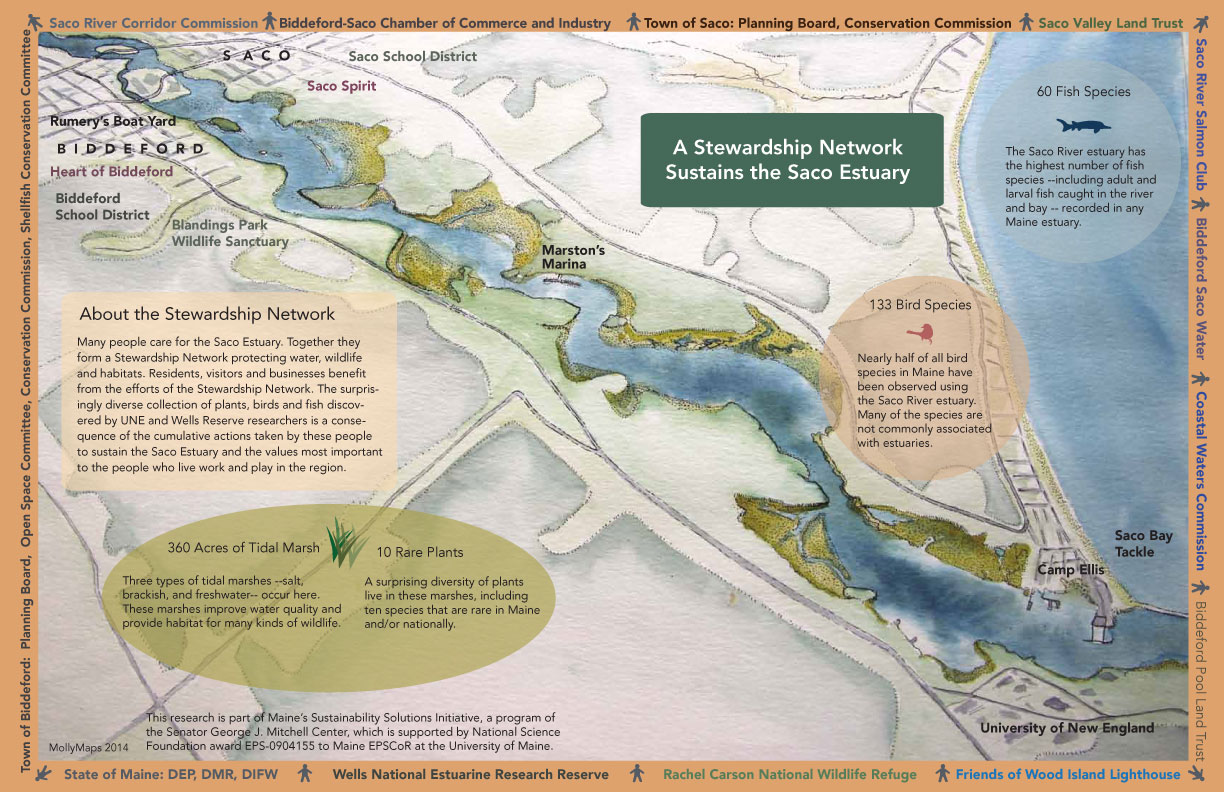
The Saco River basin is the largest watershed in southern Maine, draining about 1,700 square miles and encompassing all or part of 20 cities and towns in the state. From its headwaters in the White Mountains of New Hampshire, Maine's fourth-largest river flows roughly 120 miles before emptying into the Gulf of Maine between the cities of Biddeford and Saco.

The estuarine portion of the Saco River extends about 4 miles, from near Cataract Dam at Factory Island, Biddeford (the most seaward of the river's 40-plus dams), to Camp Ellis and Hills Beach. At the river mouth lies the University of New England campus.

Project Period

Fall 2009 to Summer 2014

Accomplishments to Date

  1. Formed research and stakeholder teams, so at each step the scientists can work with resource managers, policy makers, and decision makers.
  2. Held two Sustaining the Saco workshops to gather community input.
  3. Completed first season of ecological research on fish, bird, and plant biodiversity in tidal wetlands (second season now under way).
  4. Began mapping extent of invasive plants and measuring nitrogen content in runoff entering wetlands (summer 2011).

Community Impact

  • Information from Sustaining the Saco workshops will be included in the City of Biddeford's open space plan.

Resulting Publications

Principal Investigators

  • Pamela Morgan, Ph.D., UNE Department of Environmental Studies
  • Christine Feurt, Ph.D., director of the UNE Center for Sustainable Communities & coordinator of the Wells Reserve Coastal Training Program

Collaborators

  • Michele Dionne, Ph.D.
  • Other UNE professors

Funding Sources

  • Maine EPSCoR grant (Experimental Program to Stimulate Competitive Research, a National Science Foundation program) to the University of New England through the UMaine Sustainability Solutions Initiative. Funding partially shared with the Wells Reserve.

View more blog posts